Get Your Google Health . . . Soon

Thursday, 24 January 2008
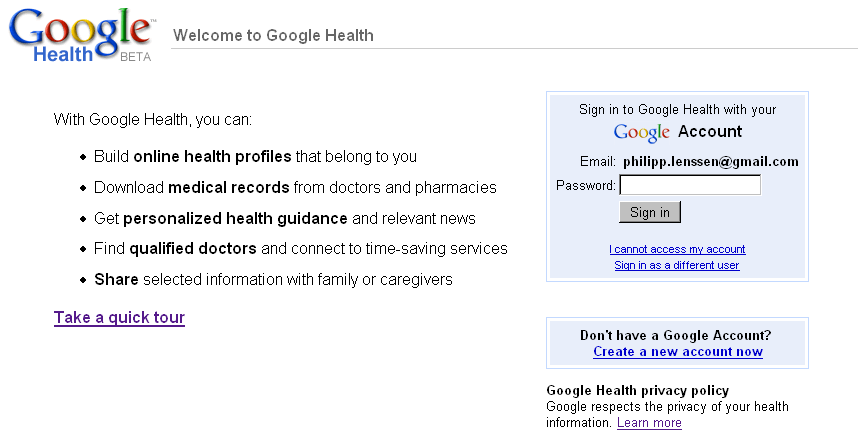
Various reports out about the coming of Google Health. As Matthew Holt indicates, the Google purists found a log in page (screen shot).

The log in page has since been pulled down but Matthew and Tech Crunch provide a list of what the log in page said Google Health will do for you, including:

With Google Health, you can:

  • Build online health profiles that belong to you
  • Download medical records from doctors and pharmacies
  • Get personalized health guidance and relevant news
  • Find qualified doctors and connect to time-saving services
  • Share selected information with family or caregivers
I'm particularly interested to check out the "Google Health Privacy Policy" which is referenced on the log in screen shot.

Stay tuned . . .

HealthBlawg Cover Northeast Health 2.0 Event

Fellow health law blogger, David Harlow, hangs with the Health 2.0 crowd at the Northeast Corridor Health 2.0 shindig in Cambridge. David provides his thoughts on where Health 2.0 might be headed. Looking forward to attending a future NE Health 2.0 event.

Mark Modzelewski, organizer of the event and author of Hub 2.0 - Boston Herald Blogs, served as moderator for the panel discussion and provides some additional commentary.

More Predictions on The Future of Health Care

Great post, "Everybody's Talking about the Future of Health Care," by Fred Fortin over at the World Health Care Blog. The post focusing our attention on what may occur in 2008.

The other day I was in a meeting related to West Virginia's efforts to create a state wide health information network. We were looking at project time lines that ran into 2010. Although only two years away I thought how long a time that is as technology, health care, political landscape, etc. move around at light speed. Similar to Mr. Fortin's thoughts and "humble appreciation and respect for the role of high impact, improbably events in social affairs."

Mr. Fortin points out in his post the key concept of "unsustainability". Which in my mind leads to major disruption in the industry. The question is when and how hard. What will be the key drivers? We have to push forward on developing models but in doing so we always have to remain aware and vigilant of what is happening around us.

Tip to Tony for pointing out the post.

Guitar Hero Health Care

Sunday, 20 January 2008
Guitar Hero (Rock Band) Health Care. The current (next) generation expects to be on the stage performing and not just sitting passively in the audience.

Check out Why Consumer - Directed Medicine, Health 2.0 Will Flourish by Jen McCabe Gorman at Health Management RX.

What the coming generation will expect from providers - read Jen's questions and formulate your answer. The task we all have in front of us is how to harness these mentoring powers to focus on preventative care, disease management and wellness.

She ends with:
Work on mentoring the 'me' generations - the next wave of healthcare delivery will depend on carefully mentoring 'me' thinkers to manage personal responsibility and maintain individual health. Wellness maintenance programs are just one part of the solution . . .

. . . Give us a solo - we've been taught for most of our lives to tell people what we want. You've been taught for most of your lives to tell people what we need to be well. Your answers about how to work with us in the new system are waiting.

The Return of Flea . . .

Thursday, 17 January 2008
An interview with Dr. Flea (Robert Lindeman, MD) from Eric Turkewitz at the New York Personal Injury Law Blog.

Thanks to Mr. Turkewitz for taking the time and effort to approach Dr. Lindeman and for Dr. Lindeman for agreeing to be interviewed. A great series of questions and answers. There is a lesson in this for all of us -- lawyers (plaintiff and defense), physician, hospital CEOs, etc.

Mr. Turkewitz followed up with Dr. Lindeman after seeing that he was interviewed for an article on Canadian doctor blogs, Check my blog and call me in the morning, by the National Review of Medicine. More on the behind the scenes interview for the article at the Canadian Medicine blog.

For more information check out my past post, "The Flea Flicker" and a follow up post highlighting an article I assisted Fard Johnmar, including some basic legal tips for physician bloggers.

Thanks to KevinMD courtesy of Althouse for the tip.

Advocating The Need For A Federal Data Breach Disclosure Law

Information Week's Security Blog advocates for a federal data breach disclosure law in this post, The Time Is Now (Better Yet, Yesterday) For A Federal Data Breach Disclosure Law.

Thanks to the HIPAA Blog for point out the article. I agree with Jeff Drummond's conclusion. After having analyzed overlapping and different state disclosure requirements as a part of assisting clients with data breach issue a federal approach is the direction we should go. (caveat: it should require total preemption - not partial preemption like HIPAA privacy).

A federal approach would help set a national industry standard that can be clearly understood, implemented and followed by those who regularly deal in data, health care or otherwise. The state-by-state patchwork of different laws that currently exist create a complexity that is not needed.

For more on the ongoing complexity issue check out California's recently revised law (AB1298) that recently took effect. AB1298 effective January 1, 2008, expands the coverage and protections to medical information and health insurance information under California's State Information Practices Act.

A clear and concise national approach would simplify compliance for those required to maintain and protect data, including health care providers maintaining health information. Customers and patients who expect their data to be maintained would also benefit by a simplified approach and uniform law that provides for a consistent level of breach notification and protection.

For more on state security breach notification legislation/laws check out the National Conference of State Legislatures website page "Breach of Information". Last updated in April 2007, it states "thirty-five states have enacted legislation requiring companies and/or state agencies to disclosure security breaches involving personal information." I suspect this number will increase after the 2008 legislative sessions around the country.

Also, NCSL provides a summary of data breach notification legislation introduced by year. For 2007, they list three bills introduced (but not passed) before the West Virginia Legislature:

WEST VIRGINIA
WV H 2175
Sponsor: Marshall (D)
Title: Acquisition of Security Compromising Data
Introduced: 01/16/2007
Location: House Judiciary Committee
Summary: Relates to the unauthorized acquisition of data that compromises the security, confidentiality, or integrity of personal information maintained by the data collector.
Status:
01/16/2007 INTRODUCED.
01/16/2007 To HOUSE Committee on JUDICIARY.

WV H 2263
Sponsor: Brown (D)
Title: Clean Credit Information and Identity Theft Protection
Introduced: 01/16/2007
Location: House Judiciary Committee
Summary: Ensures clean credit information and identity theft protection (FN).
Status:
01/16/2007 INTRODUCED.
01/16/2007 To HOUSE Committee on JUDICIARY.

WV H 2705
Sponsor: Marshall (D)
Title: Consumer Right to Impose Freeze on Credit Reports
Introduced: 01/30/2007
Location: House Judiciary Committee
Summary: Establishes a procedure whereby a consumer may implement a security freeze to prohibit a consumer reporting agency from releasing all or any part of the consumer's credit report.
Status:
01/30/2007 INTRODUCED.
01/30/2007 To HOUSE Committee on JUDICIA

As a result of high profile cases like this one that occurred in West Virginia, we will again see activity this year in West Virginia.

WVHCA: Update on the Proposed Cardiac Catheterization Standards

Monday, 14 January 2008
I previously posted about the proposed amendments to the Certificate of Need Cardiac Catheterization Standards issued by the West Virginia Health Care Authority for public comment.

Today, Charleston Gazette reporter, Eric Eyre, reports on the current debate over the standards. To learn more you can read the comments submitted regarding the proposed standards.